Health professionals who carry out well-baby and well-child check-ups for newborns, infants and children routinely perform the red reflex test (Brückner test).
In Chile, it is recommended at well-child check-ups up to age 4, and it is part of the vision screening phase of the JUNAEB program for pre-kindergarten, kindergarten and first-grade students.
The American Academy of Pediatrics recommends performing it on all newborns, so that no baby is discharged from a maternity unit without this assessment, and continuing to perform it at all medical check-ups during childhood (1,2,3).
Performing the test correctly and interpreting it properly allows timely diagnosis of eye diseases that could cause amblyopia or irreversible blindness and, above all, can warn of malignant intraocular tumors such as retinoblastoma, which is life-threatening for the child (1,2,3,4).
What is the red reflex test? (4,5)
A white light is shone onto the patient’s pupils; it reflects off the retinas and comes back out with a reddish-orange color, as in flash photographs.
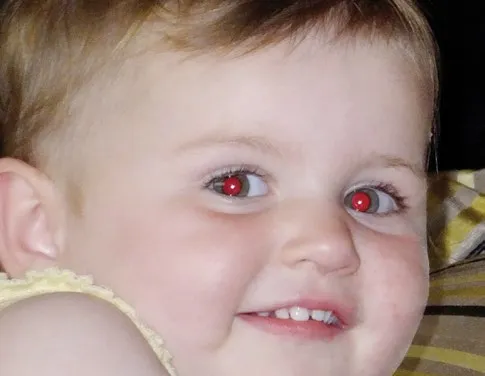
When light reflects off the retina, it comes back out with a reddish-orange color that can be seen in the pupils.
What is needed and how is the red reflex test done? (4,5)
1. An exam room where the lighting can be dimmed, so that the child’s pupils get larger.
2. A properly charged direct ophthalmoscope. Get familiar with its parts and functions in photo No. 2
Procedure (5)
- Before starting, explain to the parents and, where appropriate, to the child what the exam involves.
- The exam room should be calm, and it should be possible to dim the lighting so that the pupils stay large.
- Have two chairs: one for the patient, or for the caregiver with the patient on their lap, so that the child feels calm and safe, and another for the examiner to sit facing the patient, always with legs to the side. (Do not place the patient and/or their guardian between your legs.)
- Place the child at an arm’s length from the examiner, making sure the examiner’s eyes are at the same height as the child’s (do not examine looking down from above).
- Shine the white light of the direct ophthalmoscope at the center of the pupils of both eyes at the same time, then observe and compare by looking through the ophthalmoscope viewer (photo No. 2).
- Carry out this assessment in different gaze positions and compare one eye with the other. Remember that both eyes may show an abnormal red reflex
Interpreting the red reflex test (4,5)
Normal: Both reflexes are the same bright reddish-orange color
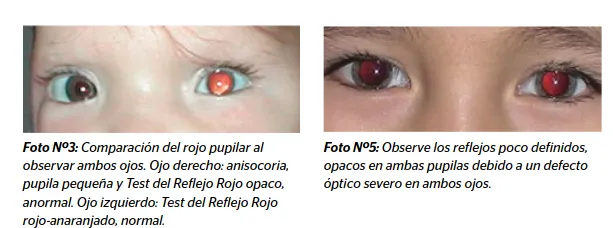
Abnormal: The following are abnormal: a dull reflex, one that reflects little light or looks faded, has spots, is absent, or a pupil that looks white (photo No. 3).
Possible findings
- Normal or abnormal, in one or both pupils
- Symmetrical or asymmetrical
An altered test indicates a problem in any of the media mentioned, so the patient must be referred urgently to an ophthalmologist.
Most common causes of an altered red reflex in children:
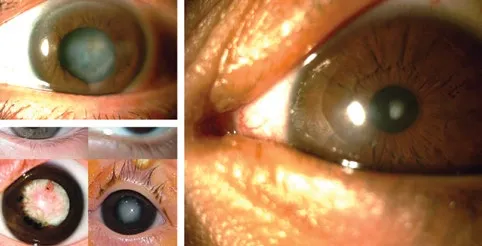
- Cataracts: a clouding of the lens. They can stop light from reaching the retina or make the rays scatter as they pass through it, which can distort the perceived image. Both can lead to reduced visual acuity and amblyopia (photo No. 4)
- Moderate or severe refractive errors, in one or both eyes. They produce a dim or weak red reflex (photo No. 5)
- Albinism. There is no pigment in the iris (it is translucent) or in the retina. The eyes look red. (Photo No. 6)
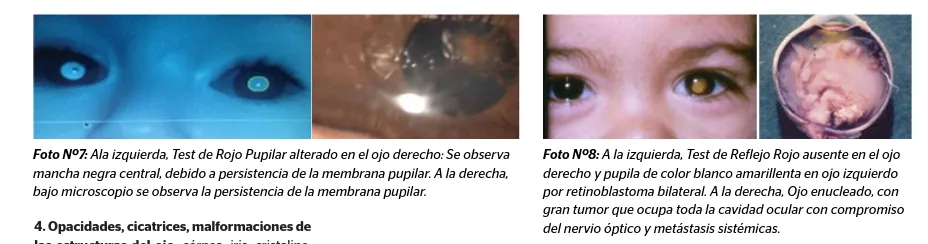
- Opacities, scars or malformations of the structures of the eye: cornea, iris, lens, vitreous humor. (Photo No. 7)
- Tumors: for example, retinoblastoma. It is the most common malignant intraocular tumor in children, with an incidence of 1 in 17,000 live births. It arises when primary retinal cells become malignant before they differentiate (photos No. 8).
- Parasitic infections: toxocariasis and toxoplasmosis affect the inside of the eye, which can show up as an altered red reflex (photo No. 10).
References
- Ministerio de salud. Norma Técnica para la supervisión de niños y niñas de 0 a 9 años en la Atención Primaria de Salud [Internet]. Chile: Ministerio de Salud; 2014 [Citado 2020 Agosto 19]. Disponible en: https://www.minsal.cl/sites/default/files/files/2014_Norma%20T%C3%A9cnica%20para%20la%20supervisi%C3%B3n%20de%20ni%C3%B1os%20y%20ni%C3%B1as%20de%200%20a%209%20en%20APS_web(1).pdf.
- Vogel M. Control de Salud Visual del Niño [Internet]. Chile; 2012. Disponible en: http://www.marlenevogel.cl/protocolo_saludvisual.pdf
- American Academy of Pediatrics Section on Ophthalmology. Red Reflex Examination in Neonates, Infants, and Children. Pediatrics. 2008; 122 (6): 1401-1403.
- Vogel M. Protocolo de normas de atención según niveles, con enfoque de integración de la atención. 1era ed. Chile: Ministerio de Salud. Servicio de Salud Metropolitano Norte Hospital de Niños Roberto del Río.2012
- Goya C, Armanet L y Salazar AM. Manual de Gestión de Tamizaje Visual. 1era ed. Chile: Facultad de Medicina, Universidad de Chile, JUNAEB, Ministerio de Educación; 2014.